
Every surgical intervention is always associated with the risk of infection, requires a sterile operating room and implies a long recovery period.
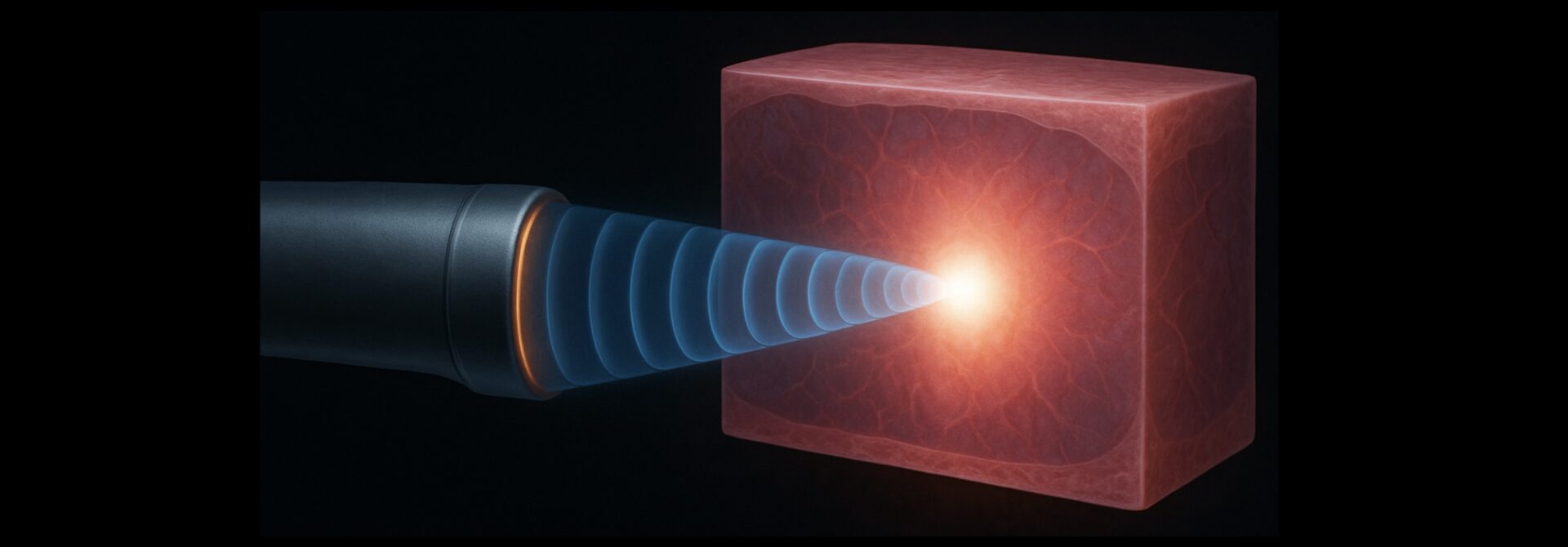
Ultrasonic waves of large amplitude are capable of not only changing as they propagate due to the nonlinear response of the medium, but also (at a sufficiently high intensity) destroying the medium. This feature of ultrasound has found its application in medicine. The precision of such a “disembodied scalpel” on tissue is achieved by focusing the ultrasound beams on the target site.
High-intensity Focused Ultrasound (HIFU) is already successfully used in clinical practice for non-surgical fractionation of neoplasms in various organs, as well as for neurosurgical operations in deep structures of the human brain. In existing clinical HIFU systems, the main mechanism of action on tissue is its heating in the harmonic wave regimes to the temperatures of thermal necrosis, thus “cooking” the target tissue non-invasively (i.e., contactlessly, without an incision).
However, the HIFU regimes currently used in clinical practice lack precision due to heat diffusion beyond the target area. To avoid heat diffusion, more powerful shock wave regimes that are being developed at LIMU can be used.
Research at LIMU
- development of complex methods for planning HIFU exposure in clinical settings;
- transducer design, including phased arrays, to achieve the required amplitudes of shock fronts at the focus;
- studies of physical mechanisms affecting tissue exposed to shock-wave HIFU;
- investigation of the effect of tissue acoustic properties on nonlinear focusing and field parameters in situ;
- investigation of acoustic and MRI visualization of the treated area;
- analysis of morphological and ultrastructural changes in tissue induced by ultrasound.
LIMU tasks
- Numerical development of new shock-wave HIFU regimes
- Verification experiments on tissue phantoms
- Design of specialized transducers for specific clinical applications
Activity types
- numerical modeling
- experiments
- transducer design
Contacts
Details
[1] Physical mechanisms of the therapeutic effect of ultrasound (a review) / M. R. Bailey, V. A. Khokhlova, O. A. Sapozhnikov et al. // Acoustical Physics. — 2003. — Vol. 49, no. 4. — P. 369–388. DOI: 10.1134/1.1591291
[2] The use of focused ultrasound beams with shocks to suppress diffusion effects in volumetric thermal ablation of biological tissue / P. A. Pestova, M. M. Karzova, P. V. Yuldashev, V. A. Khokhlova // Acoustical Physics. — 2023. — Vol. 69, no. 4. — P. 448–458. DOI: 10.1134/S1063771023600468
[3] High-intensity focused ultrasound: current potential and oncologic applications / T. J. Dubinsky, C. Cuevas, M. K. Dighe, O. Kolokythas, J. H. Hwang // AJR Am J Roentgenol. —2008. — Vol. 190, no. 1. — P. 191-199. DOI: 10.2214/AJR.07.2671
[4] Impact of the trajectory of treatment on the rate of thermal ablation and ablated volume of biological tissue irradiated by shockwave focused ultrasonic exposure / P. A. Pestova, P. V. Yuldashev, V. A. Khokhlova, M. M. Karzova // Bulletin of the Russian Academy of Sciences: Physics. — 2024. — Vol. 88, no. 1. — P. 108–112. DOI: 10.1134/S1062873823705068
[5] Thermal ablation of biological tissue by sonicating discrete foci in a specified volume with a single wave burst with shocks / P. A. Pestova, P. V. Yuldashev, V. A. Khokhlova, M. M. Karzova // Acoustical Physics. — 2024. — Vol. 70, no. 3. — P. 434–443. DOI: 10.1134/S1063771024601663
[6] Comparative characterization of nonlinear ultrasound fields generated by Sonalleve V1 and V2 MR-HIFU systems / M. M. Karzova, W. Kreider, A. Partanen et al. // IEEE Transactions on Ultrasonics, Ferroelectrics, and Frequency Control. — 2023. — Vol. 70, no. 6. — P. 521–537. DOI: 10.1109/TUFFC.2023.3261420
[7] Accelerated thermal ablation of biological tissue volumes using HIFU beams with shock fronts / Y. S. Andriyakhina, M. M. Karzova, P. V. Yuldashev, V. A. Khokhlova // Acoustical Physics. — 2019. — Vol. 65, no. 2. — P. 141–150. DOI: 10.1134/S1063771019020015
[8] Nonlinear acoustics today / O. A. Sapozhnikov, V. A. Khokhlova, R. O. Cleveland et al. // Acoustics today. — 2019. — Vol. 15, no. 3. — P. 55–64. DOI: 10.1121/AT.2019.15.3.55
[9] Physical mechanisms of the therapeutic effect of ultrasound (a review) / M. R. Bailey, V. A. Khokhlova, O. A. Sapozhnikov et al. // Acoustical Physics. — 2003. — Vol. 49, no. 4. — P. 369–388. DOI: 10.1134/1.1591291