A top-rated journal The Journal of the Acoustical Society of America (Q1, IF 2.1) has published our article “Fully nonlinear three-dimensional modeling of parametric interactions in the field of a dual-frequency acoustic array” based on the results of our joint research with Gubkin Russian State University of Oil and Gas.
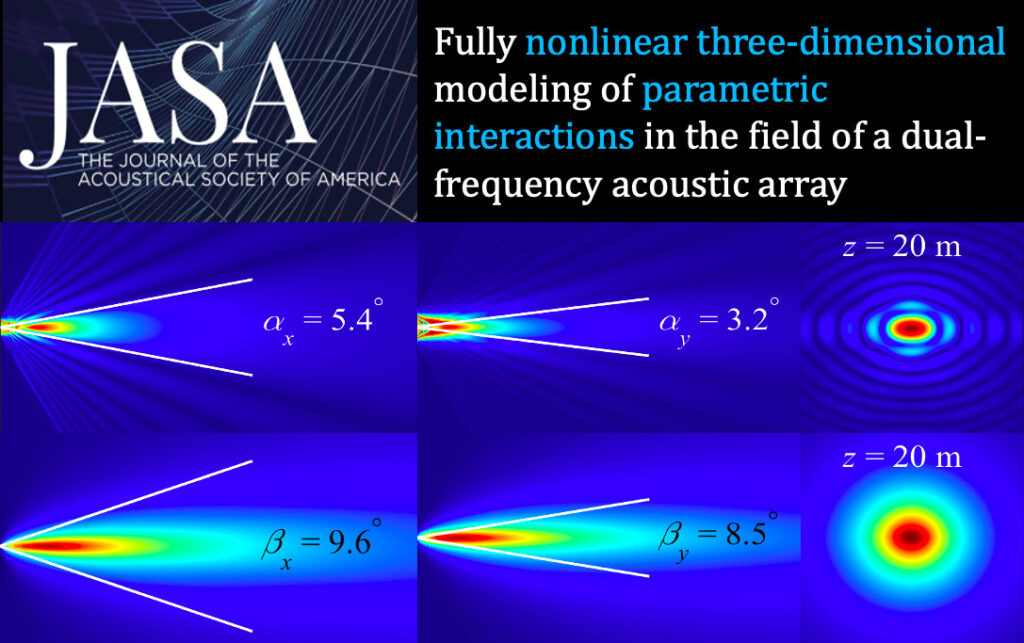
When two intense high-frequency waves interact in the nonlinear medium, a set of harmonics (frequencies) is generated but only a difference-frequency wave (with the lowest frequency) can propagate at a sufficient distance from the transducer (high-frequency waves dissipate rapidly).
Therefore, parametric generation of a difference-frequency wave is actively used in various applications:
- highly directional audible sound in the air (contactless audio guides in the libraries and museums, active noise control systems);
- highly directional signal that propagates over long distances in the water (profiling sea-bottom structures and long-range ocean research);
- medical applications (ultrasound difference-frequency imaging, contrast elastography), etc.
However, numerical modelling of parametric interactions is extremely cumbersome in terms of required time and memory costs. Therefore, the existing numerical algorithms solve quasi-linear problems and/or in 2D (and even 1D) formulation.
In our published paper, a new optimized numerical algorithm with filtering the spectrum has been developed that allows solving 3D parametric problems in highly nonlinear modes, and the features of parametric difference-frequency wave generation have been studied.
As a result, it is shown that:
- quasi-linear approximation is improper at high pressures on the transducer (pressure amplitudes and waves divergence are incorrectly described);
- the efficiency of difference-frequency wave generation increases with an increase in the initial power of the pump waves;
- but this is accompanied by an additional widening of the difference-frequency beam.
Thus, numerical 3D nonlinear modelling serves as a tool for determining optimal pump radiation parameters in order to increase the difference-frequency output power while maintaining the desired directivity of the beam.For more details – see the text of the paper.