
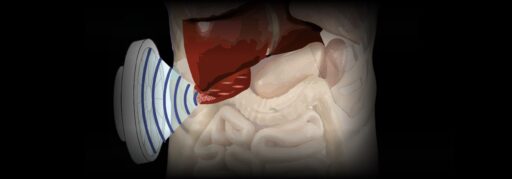
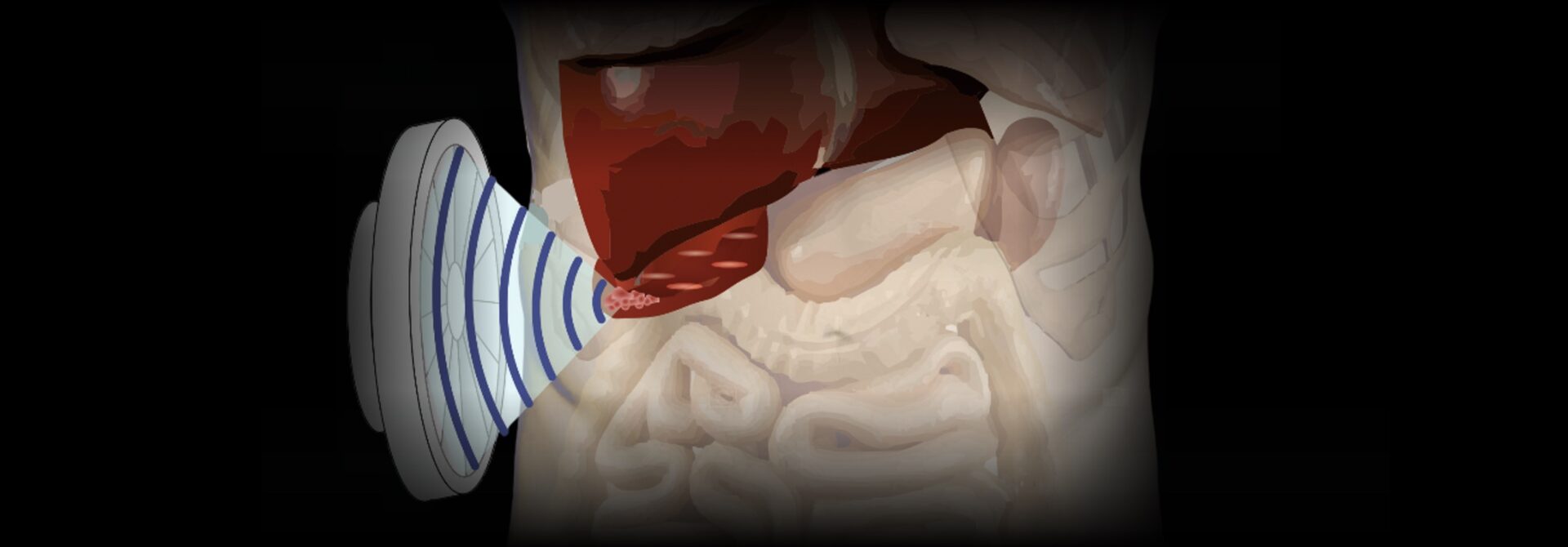
Internal hematomas (intraperitoneal, retroperitoneal and intramuscular) are accumulations of clotted blood within soft tissues occurring as a result of hemorrhage from damaged blood vessels secondary to trauma or surgery. Treatment of such large (from hundred milliliters to several liters) extravascular hematomas, localized, e.g., in the abdominal cavity, is an important clinical problem. A hematoma located in between organs exerts excessive pressure on these organs which can lead to compartment syndrome and organ failure. There is also a high probability of secondary infection with further abscess formation.
Standard treatment methods for large hematomas are not effective enough. In particular, supportive therapy is not applicable in the cases of large deep hematomas, angioembolization is not suitable for large vessels, drainage through percutaneous drains is also usually ineffective due to the gel-like structure of the hematoma. Conservative treatment takes several weeks and is not suitable for symptomatic hematomas that cause pain or have a risk of compartment syndrome or organ failure. Surgical treatment is an effective method but is associated with traumatic intervention and the possibility of serious complications.
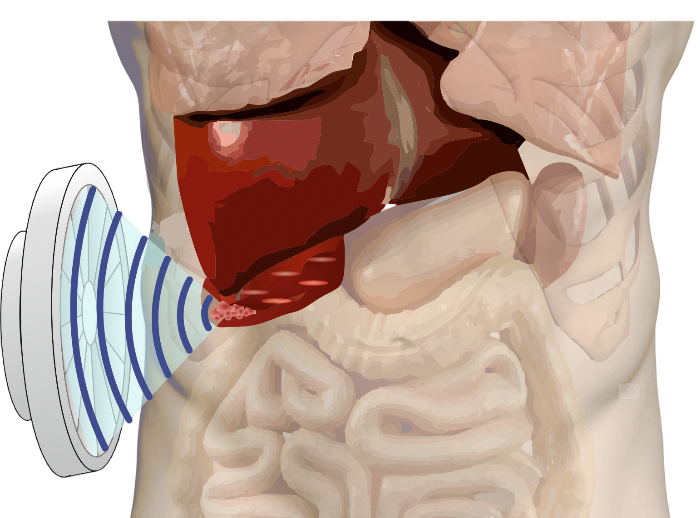
LIMU is developing a new minimally invasive approach – the boiling histotripsy method – which implies the use of repeating focused shock-wave pulses for transcutaneous liquefaction of hematomas with subsequent aspiration (i.e., removal) of the resulting liquid with a thin needle.
Our team has already conducted successful in vitro experiments on non-invasive liquefaction of hematoma models from porcine and human blood with subsequent aspiration of the liquified content under ultrasound control. For the first time, the results of mechanical liquefaction of hematomas were analyzed using scanning electron microscopy at the Center for Collective Use of the Biological Faculty of Moscow State University. It was shown that the maximum size of residual fragments does not exceed 210 μm which does not exceed the diameter of the hole of medical needles used in clinical practice. These results have shown the potential of using boiling histotripsy to rapidly and non-invasively break down large hematomas within clinically relevant time into the debris sufficiently small for subsequent fine-needle aspiration.
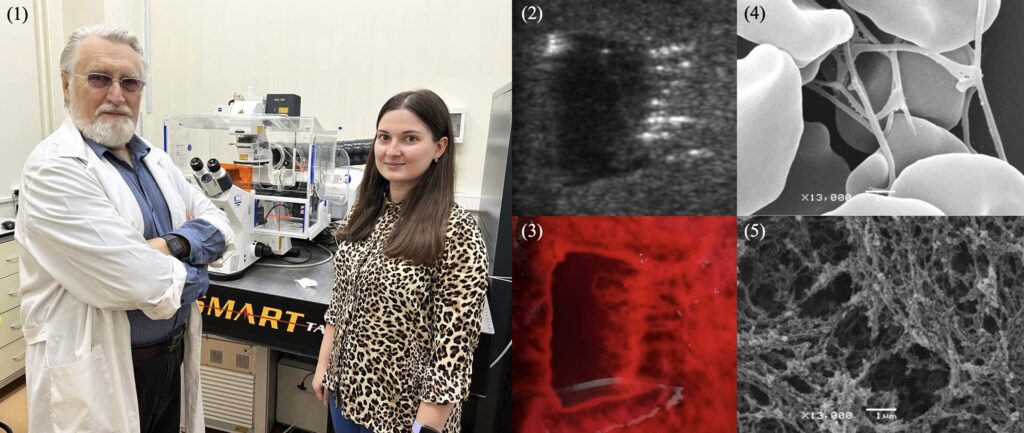
Recently, we have also performed experiments investigating mechanical properties of hematomas using shear wave elastography and to study the effect of these properties on the sensitivity of hematomas to their liquefaction using boiling histotripsy. The results indicate that hematoma susceptibility to histotripsy liquefaction is not entirely determined by its stiffness, but also correlates with the retraction degree given a constant shear modulus and ultrastructure of the fibrin network holding the hematoma together.
The LIMU team has also performed a series of studies on the safety of boiling histotripsy liquefaction near air-containing organs (such as lungs, intestines, etc.), often adjacent to hematomas in the human body. Correlation of experimentally obtained damage zones with numerically calculated ultrasound fields produced in the experiment made it possible to outline the danger zones for the tissue-air boundary around the beam focus based on the structure of the generated ultrasound field and typical sizes of boiling histotripsy lesions in bulk of soft tissue. These pressure-based danger zones can be superimposed onto in-treatment ultrasound images during BH of soft tissues and used to plan safe ablation of the target area for surrounding organs.
Contacts
Details
[1] Elastic properties of aging human hematoma model in vitro and its susceptibility to histotripsy liquefaction / E. M. Ponomarchuk, P. B. Rosnitskiy, S. A. Tsysar et al. // Ultrasound in Medicine and Biology. — 2024. — Vol. 50, no. 6. — P. 927–938. DOI: 10.1016/j.ultrasmedbio.2024.02.019
[2] Mechanical damage thresholds for hematomas near gas-containing bodies in pulsed HIFU fields / E. M. Ponomarchuk, C. Hunter, M. Song et al. // Physics in Medicine and Biology. — 2022. — Vol. 67, no. 21. — P. 1–18. DOI: 10.1088/1361-6560/ac96c7
[3] Ultrastructural analysis of volumetric histotripsy bio-effects in large human hematomas / E. M. Ponomarchuk, P. B. Rosnitskiy, T. D. Khokhlova et al. // Ultrasound in Medicine and Biology. — 2021. — Vol. 47, no. 9. — P. 2608–2621. DOI: 10.1016/j.ultrasmedbio.2021.05.002
[4] Effect of stiffness of large extravascular hematomas on their susceptibility to boiling histotripsy liquefaction in vitro / T. D. Khokhlova, J. C. Kucewicz, E. M. Ponomarchuk et al. // Ultrasound in Medicine and Biology. — 2020. — Vol. 46, no. 8. — P. 2007–2016. DOI: 10.1016/j.ultrasmedbio.2020.04.023
[5] The histotripsy spectrum: differences and similarities in techniques and instrumentation / R.P. Williams, J.C. Simon, V.A. Khokhlova, O.A. Sapozhnikov, T.D. Khokhlova // International Journal of Hyperthermia, 40 1 1-19. DOI: 10.1080/02656736.2023.2233720
[6] Nonlinear acoustics today / O. A. Sapozhnikov, V. A. Khokhlova, R. O. Cleveland et al. // Acoustics today. — 2019. — Vol. 15, no. 3. — P. 55–64. DOI: 10.1121/AT.2019.15.3.55
[7] Shock-induced heating and millisecond boiling in gels and tissue due to high intensity focused ultrasound / M. S. Canney, V. A. Khokhlova, O. V. Bessonova et al. // Ultrasound in Medicine and Biology. — 2010. — Vol. 36, no. 2. — P. 250–267. DOI: 10.1016/j.ultrasmedbio.2009.09.010
[8] Controlled tissue emulsification produced by high intensity focused ultrasound shock waves and millisecond boiling / T. D. Khokhlova, M. S. Canney, V. A. Khokhlova et al. // Journal of the Acoustical Society of America. — 2011. — Vol. 130, no. 5. — P. 3498–3510. DOI: 10.1121/1.3626152
[9] Physical mechanisms of the therapeutic effect of ultrasound (a review) / M. R. Bailey, V. A. Khokhlova, O. A. Sapozhnikov et al. // Acoustical Physics. — 2003. — Vol. 49, no. 4. — P. 369–388. DOI: 10.1134/1.1591291