
Phased ultrasound arrays with an element size smaller than the wavelength are a common tool for constructing images of human internal organs in diagnostic ultrasound systems. Such arrays operate at low power and provide the ability to electronically move the field focus in a wide range and safe levels of exposure to tissues and organs for patients.
For non-invasive ultrasound surgery devices using high-intensity focused ultrasound, it is necessary to use intensities that are two to three orders of magnitude higher and ensure both the effectiveness of exposure in a given area and safety for surrounding tissues. High power requires the use of two-dimensional arrays with element sizes of several wavelengths.
With a regular arrangement of elements, electronic movement of the focus leads to the formation of undesirable side diffraction lobes. To suppress them, a quasi-random arrangement of elements was proposed by L.R. Gavrilov and is already being used by many research groups around the world. However, the filling factor of the array surface with elements in such arrays does not exceed 60%.
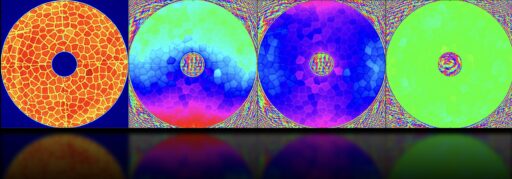
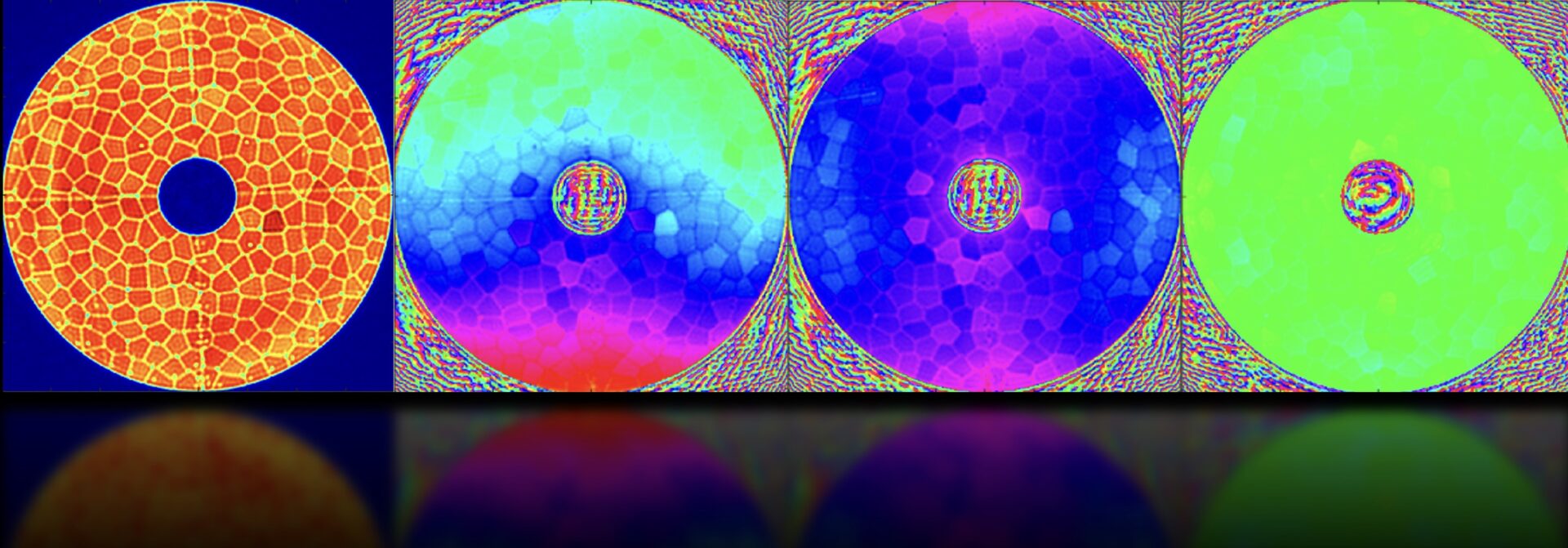
To develop powerful arrays with a limited aperture, new designs of compact arrays with increased element packing density have recently been developed at the LIMU Laboratory. This way, an original solution was implemented in the form of an absolutely dense mosaic irregular structure of elements of the same area. A corresponding array with an operating frequency of 1.2 MHz was developed and manufactured by Imasonic for HIFU research, in particular, for generating fields of various configurations and compensating for aberrations when focusing through inhomogeneous tissue layers.
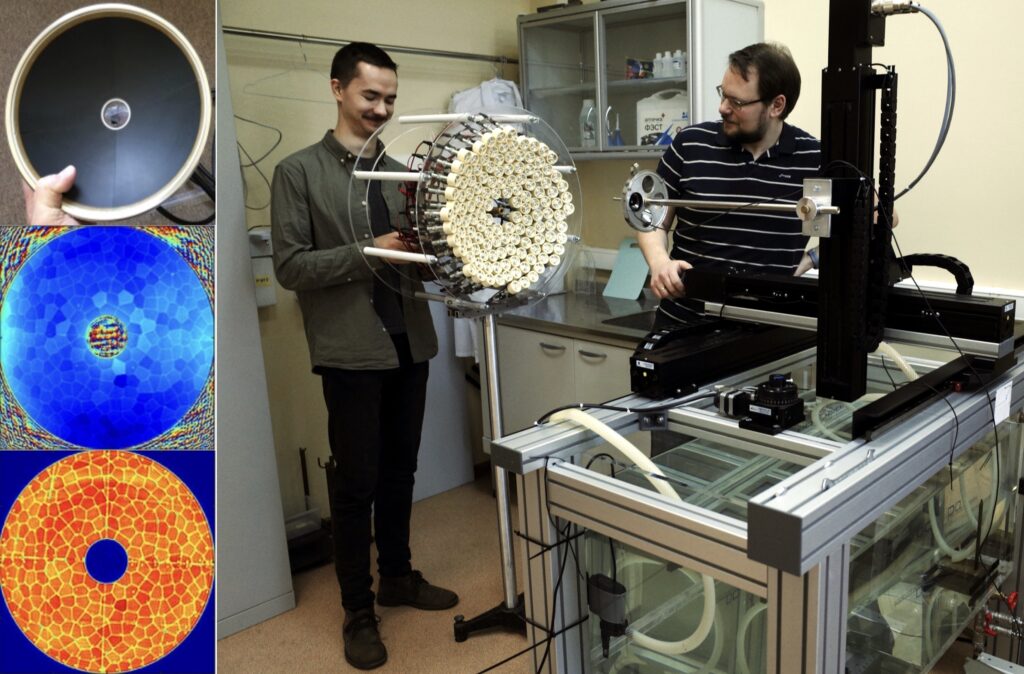
Recently, the LIMU Laboratory also developed an array with a dense spiral arrangement of elements for the use in air, which will allow experiments on the generation of flows and levitation of objects in the air. Currently, experiments on acoustic holography and characterization of the fields generated by this array are underway.
Activity types
- numerical modeling
- experiments
Patents
- P.B. Rosnitskiy, V.A. Khokhlova, L.R. Gavrilov, B.A. Vysokanov, O.A. Sapozhnikov.
“Method and device for creation of high-intensity focused ultrasound fields for noninvasive local destruction of biological tissue”
Patent No. 2662902
Contacts
Details
- in our webinar
- in the papers below
[1] Method for designing multielement fully populated random phased arrays for ultrasound surgery applications / P. B. Rosnitskiy, B. A. Vysokanov, L. R. Gavrilov et al. // IEEE Transactions on Ultrasonics, Ferroelectrics, and Frequency Control. — 2018. — Vol. 65, no. 4. — P. 630–637. DOI: 10.1109/TUFFC.2018.2800160
[2] Designing fully populated phased arrays for noninvasive ultrasound surgery with controlled degree of irregularity in the arrangement of elements / P. B. Rosnitskiy, O. A. Sapozhnikov, L. R. Gavrilov, V. A. Khokhlova // Acoustical Physics. — 2020. — Vol. 66, no. 4. — P. 352–361. DOI: 10.1134/S1063771020040090
[3] Synthesized acoustic holography: A method to evaluate steering and focusing performance of ultrasound arrays / R. P. Williams, W. Kreider, F. A. Nartov, M. M. Karzova, V. A. Khokhlova, O. A. Sapozhnikov, T. D. Khokhlova // Journal of the Acoustical Society of America — 2025. — Vol. 157, no. 4. — P. 2750–2762. DOI: 10.1121/10.0036225
[4] Phase correction of the channels of a fully populated randomized multielement therapeutic array using the acoustic holography method / S. A. Tsysar, P. B. Rosnitskiy, S. A. Asfandiyarov et al. // Acoustical Physics. — 2024. — Vol. 70, no. 1. — P. 82–89.
[5] A prototype therapy system for boiling histotripsy in abdominal targets based on a 256 element spiral array / C. R. Bawiec, T. D. Khokhlova, O. A. Sapozhnikov et al. // IEEE Transactions on Ultrasonics, Ferroelectrics, and Frequency Control. — 2021. — Vol. 68, no. 5. — P. 1496–1510. DOI: 10.1109/TUFFC.2020.3036580
[6] Field characterization and compensation of vibrational non-uniformity for a 256-element focused ultrasound phased array / M. A. Ghanem, A. D. Maxwell, W. Kreider et al. // IEEE Transactions on Ultrasonics, Ferroelectrics, and Frequency Control. — 2018. — Vol. 65, no. 9. — P. 1618–1630. DOI: 10.1109/TUFFC.2018.2851188
[7] On the possibility of using multi-element phased arrays for shock-wave action on deep brain structures / P. Rosnitskiy, L. Gavrilov, P. Yuldashev et al. // Acoustical Physics. — 2017. — Vol. 63, no. 5. — P. 531–541. DOI: 10.1134/S1063771017050104
[8] Spiral arrangement of elements of two-dimensional ultrasonic therapeutic arrays as a way of increasing the intensity at the focus / L.R. Gavrilov, O.A. Sapozhnikov, V.A. Khokhlova // Bulletin of the Russian Academy of Sciences: Physics. — 2015. — Vol. 79, no. 10. — P. 1232–1237. DOI: 10.3103/S106287381510010X
[9] A multi-element interstitial ultrasound applicator for the thermal therapy of brain tumors / M. Canney, F. Chavrier, S. Tsysar et al. // Journal of the Acoustical Society of America. — 2013. — Vol. 134, no. 2. — P. 1647–1655. DOI: 10.1121/1.4812883
[10] Characterization of a multi-element clinical HIFU system using acoustic holography and nonlinear modeling / W. Kreider, P. V. Yuldashev, O. A. Sapozhnikov et al. // IEEE Transactions on Ultrasonics, Ferroelectrics, and Frequency Control. — 2013. — Vol. 60, no. 8. — P. 1683–1698. DOI: 10.1109/TUFFC.2013.2750
[11] Heating of biological tissues by two-dimensional phased arrays with random and regular element distributions / E. A. Filonenko, L. R. Gavrilov, V. A. Khokhlova, J. W. Hand // Acoustical Physics. — 2004. — Vol. 50, no. 2. — P. 222–231.