
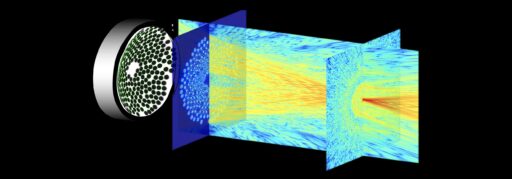
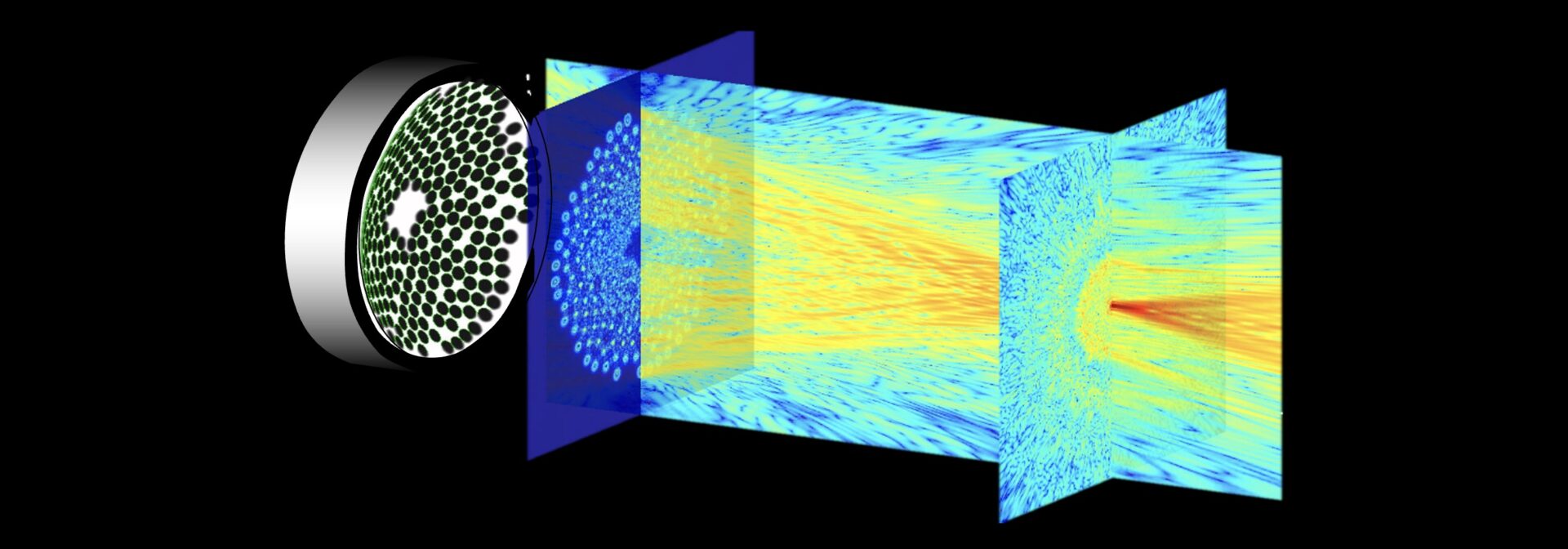
For the use of ultrasound transducers in medicine or industry, it is crucial to accurately predict the fields they generate. The existing methods are not accurate enough, especially for high-intensity ultrasound fields, which can limit the safety and efficiency of ultrasound exposure. For high-precision characterization of ultrasound fields, a method of acoustic holography was proposed, similar to optical holography.
Holography, generally, implies recording of complete information about a wave field (hologram). In the case of harmonic waves, not only the amplitude but also the phase of the wave is recorded. According to the general properties of the wave equation solutions, such recording is sufficient to be made on a certain surface surrounding the visualized object.
Soon after D. Gabor received the Nobel Prize for the development of the principle of optical holography, several versions of holography for acoustic waves were proposed and implemented, similar to the optical recording principle. However, it later became clear that in acoustics it is possible to avoid the use of interference with an auxiliary reference beam. Due to the relatively low frequency of acoustic signals, it is possible to directly record the amplitude and phase of the wave on the studied surface and then numerically recreate the original field throughout the entire space.
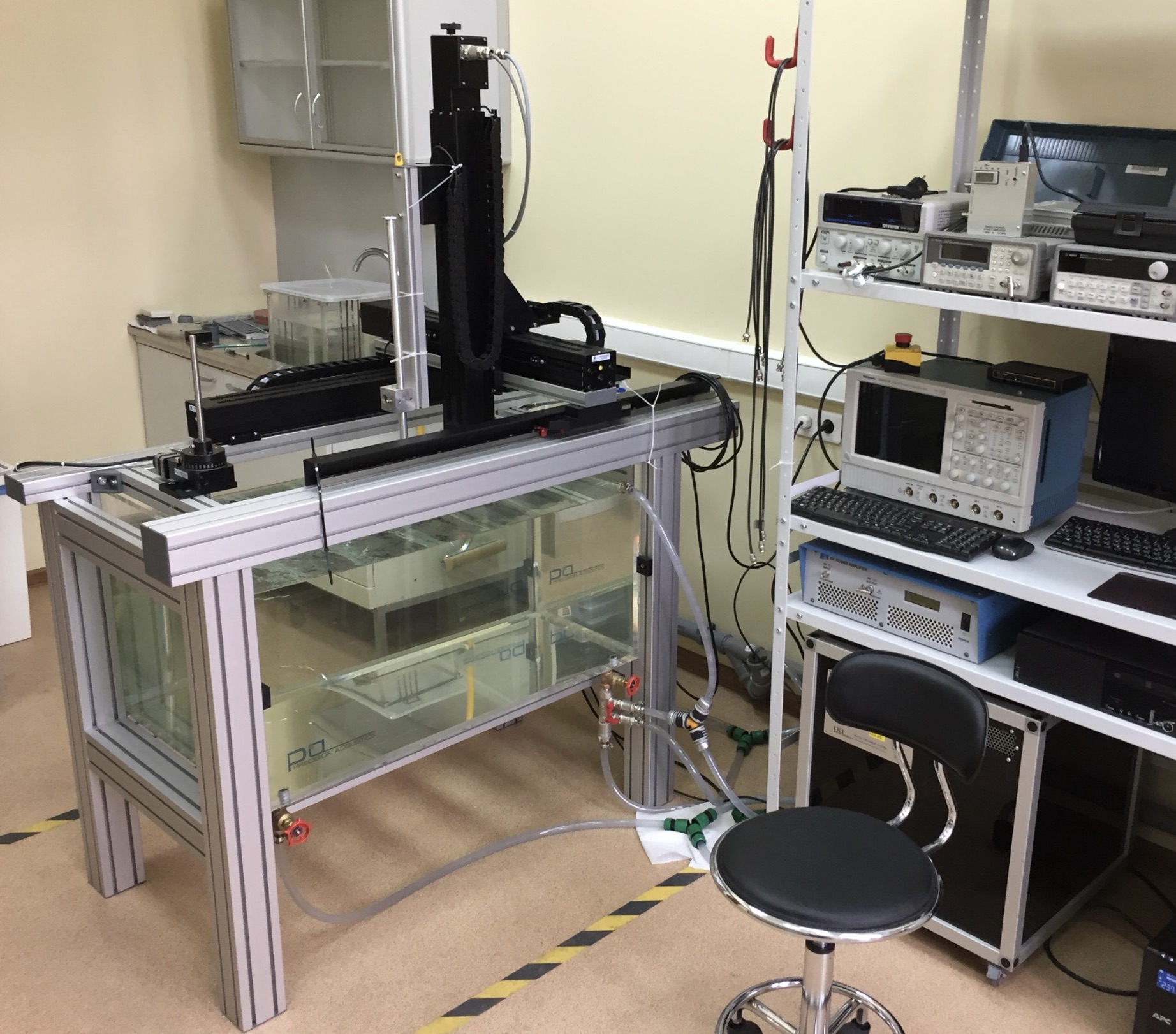
Experimental stand for acoustic holography measurements using the method of synthesizing two-dimensional receiving arrays
An approach for megahertz ultrasonic waves in liquids was first developed and implemented at LIMU Laboratory. The essence of the method is to calculate the characteristics of the wave field in space based on the experimentally measured distribution of the amplitude and phase of the acoustic pressure on a certain surface in front of the source. Moreover, in the case of non-sinusoidal (for example, pulsed) signals, their full time form can be recorded at surface points. Such recording is termed a non-stationary hologram.
An acoustic hologram allows for high-precision calculations of the spatio-temporal structure of a wave both in the direction away from the source and towards it, including finding the acoustic pressure and oscillation velocity on the acoustic source itself. This makes it possible to reconstruct the boundary condition on the source and use it to solve the wave equation.
It is important that such an experimental boundary condition, found in the linear mode, can be transferred to high-intensity modes by scaling the oscillation amplitude on the source, when the wave propagates nonlinearly, up to the formation of shock fronts in the wave profile.
The developed method for investigating ultrasonic sources and the fields they generate has been convincingly and repeatedly demonstrated in practice, which led to its inclusion in the International Electrotechnical Commission (IEC) standard.
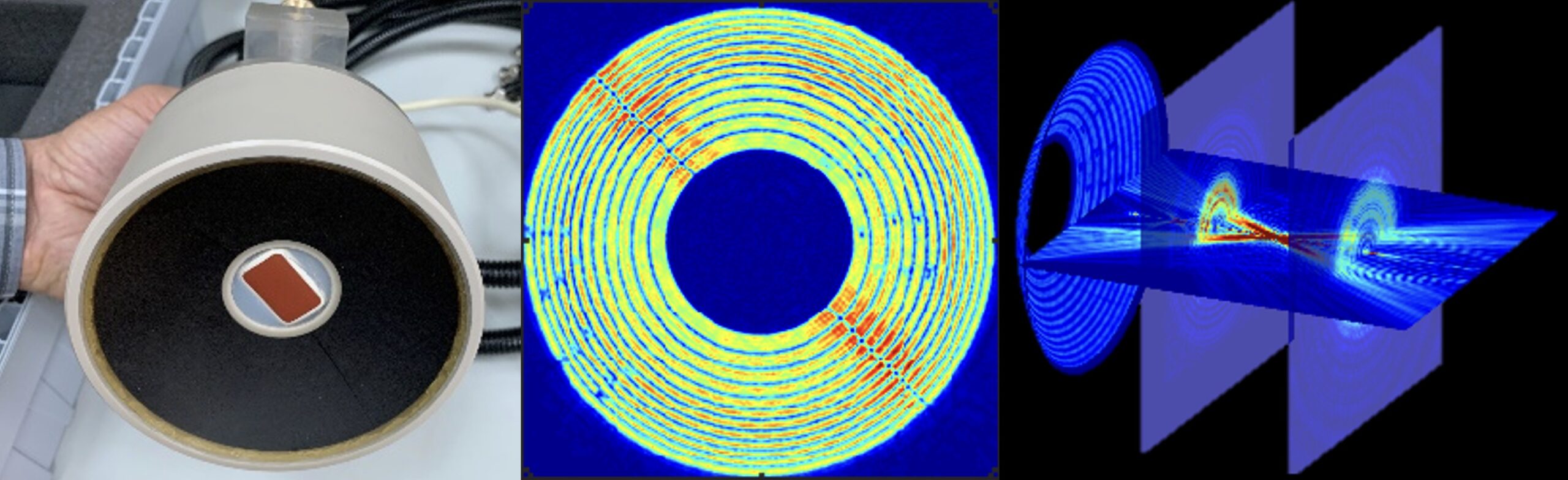
LIMU tasks
- Development and optimization of new holography methods (fast and nonlinear)
- Characterization of ultrasound fields of new transducers with acoustic holography
Activity types
- experiment
- numerical modeling
Contacts
Details
- in our lecture
- in the papers below
[1] Acoustic holography as a metrological tool for characterizing medical ultrasound sources and fields / O. A. Sapozhnikov, S. A. Tsysar, V. A. Khokhlova, W. Kreider // Journal of the Acoustical Society of America. — 2015. — Vol. 138, no. 3. — P. 1515–1532. DOI: 10.1121/1.4928396
[2] Broadband vibrometry of a two-dimensional ultrasound array using transient acoustic holography / S.A.Tsysar, D.A. Nikolaev, O.A. Sapozhnikov // Acoustical Physics. — 2021. — Vol. 67, no. 3. — P. 320–328. DOI: 10.1134/S1063771021030131
[3] Holographic extraction of plane waves from an ultrasound beam for acoustic characterization of an absorbing layer of finite dimensions / D. A. Nikolaev, S. A. Tsysar, V. A. Khokhlova et al. // Journal of the Acoustical Society of America. — 2021. — Vol. 149, no. 1. — P. 386–404. DOI: 10.1121/10.0003212
[4] Synthesized acoustic holography: A method to evaluate steering and focusing performance of ultrasound arrays / R. P. Williams, W. Kreider, F. A. Nartov, M. M. Karzova, V. A. Khokhlova, O. A. Sapozhnikov, T. D. Khokhlova // Journal of the Acoustical Society of America — 2025. — Vol. 157, no. 4. — P. 2750–2762. DOI: 10.1121/10.0036225
[5] Phase correction of the channels of a fully populated randomized multielement therapeutic array using the acoustic holography method / S. A. Tsysar, P. B. Rosnitskiy, S. A. Asfandiyarov et al. // Acoustical Physics. — 2024. — Vol. 70, no. 1. — P. 82–89. DOI: 10.1134/S1063771023601280
[6] Determination and compensation of axes misalignment of three-coordinate positioning systems using acoustic holography / D.A. Nikolaev, S.A.Tsysar, O.A. Sapozhnikov // Bulletin of the Russian Academy of Sciences: Physics. — 2021. — Vol. 85, no. 6. — P. 658–664.
[7] Using acoustic holography to characterize absorbing layers / D. Nikolaev, S. Tsysar, A. Krendeleva et al. // Proceedings of Meetings on Acoustics. — 2019. — Vol. 38, no. 045012. — P. 1–5. DOI: 10.1121/2.0001120
[8] Characterization of a multi-element clinical HIFU system using acoustic holography and nonlinear modeling / W. Kreider, P. V. Yuldashev, O. A. Sapozhnikov et al. // IEEE Transactions on Ultrasonics, Ferroelectrics, and Frequency Control. — 2013. — Vol. 60, no. 8. — P. 1683–1698. DOI: 10.1109/TUFFC.2013.2750
[9] Characterization of cylindrical ultrasonic transducers using acoustic holography / S.A. Tsysar, Y.D. Sinelnikov, O.A. Sapozhnikov // Acoustical Physics. — 2011. — Vol. 57, no. 1. — P. 94–105. DOI: 10.1134/S1063771011010167
[10] Transient acoustic holography for reconstructing the particle velocity of the surface of an acoustic transducer / Sapozhnikov O. A., Ponomarev A. E., Smagin M. A. // Acoustical Physics. — 2006. — Vol. 52, no. 3. — P. 324–330. DOI: 10.1134/S1063771006030134