
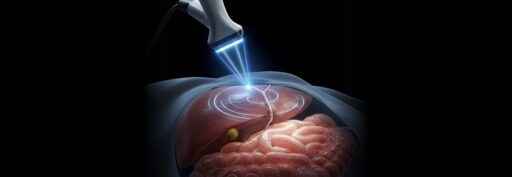
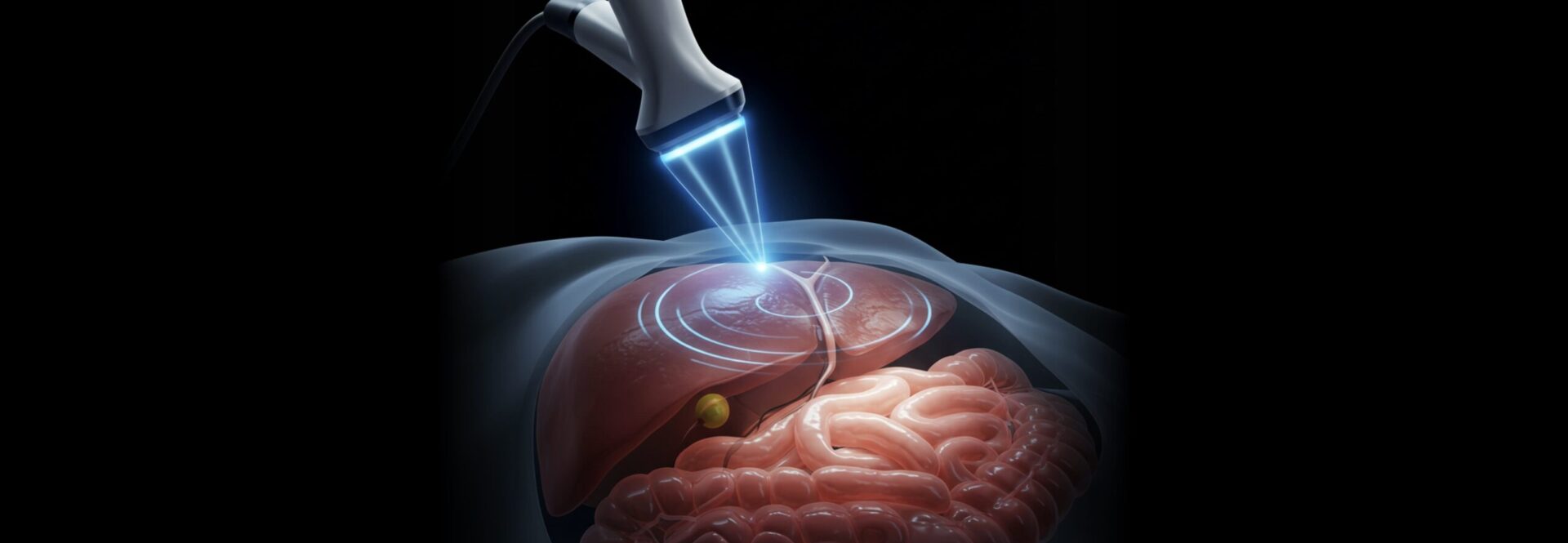
Ultrasonic waves of large amplitude are capable of not only changing as they propagate due to the nonlinear response of the medium, but also (at a sufficiently high intensity) destroying the medium. This feature of ultrasound has found its application in medicine. The precision of such a “disembodied scalpel” on tissue is achieved by focusing the ultrasound beams on the target site.
Ultrasound waves of large amplitude are able not only to distort as they propagate due to the nonlinear response of the medium, but also (at a sufficiently high intensity) destroying the medium. This possibility has found its application in medicine. The local effect of such a “disembodied scalpel” on biological tissue is achieved by focusing ultrasound beams.
High-intensity Focused Ultrasound (HIFU) is already successfully used in clinical practice for non-surgical fractionation of neoplasms in various organs, as well as for neurosurgical operations in deep structures of the human brain.
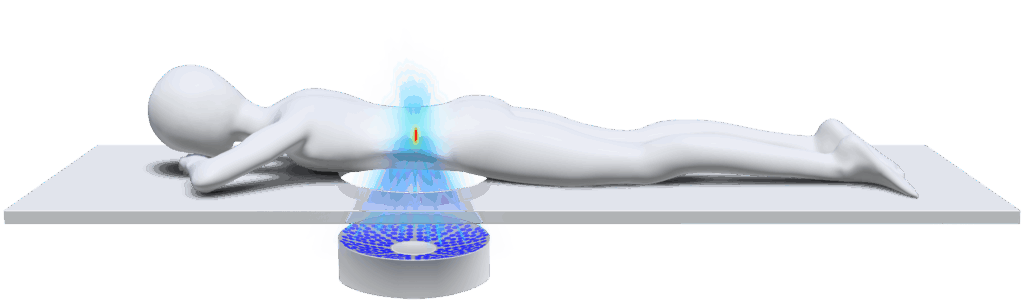
In existing clinical HIFU systems, the main mechanism of action on tissue is its heating in the harmonic wave regimes to the temperatures of thermal necrosis, thus “cooking” the target tissue non-invasively (i.e., contactlessly, without an incision).
In existing clinical HIFU systems, the main type of action on tissue is continuous HIFU exposure with harmonic waves with intensities up to 1 kW/cm2 resulting in local heating and thermal denaturation of tissue at the focus due to the absorption of ultrasound energy. However, some of its disadvantages have already been identified:
- reliable temperature control in the focal area requires expensive MRI control.
- heat diffusion from the focus to surrounding healthy tissue reduces the treatment accuracy;
- blood flow cools down the focal area and suppresses the required heat accumulation;
- thermally coagulated tissue resorbs slowly;
Therefore, there has been an increased interest in mechanical action of pulsed ultrasound with an intensity at the focus of about 1 kW/cm2 and higher, when high-amplitude shock fronts are formed in the wave profile at the focus, without causing thermal denaturation of tissue. Such regimes allow expanding the range of bioeffects caused by ultrasound.
Boiling histotripsy method
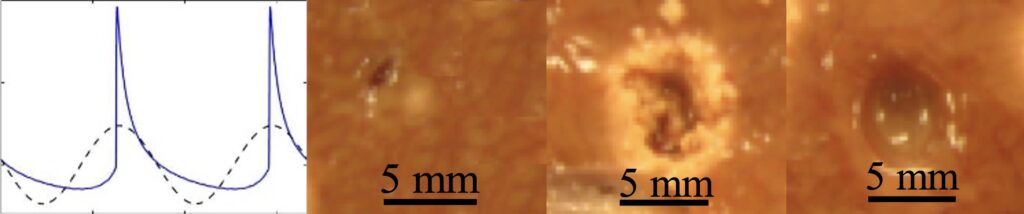
The use of shock-wave regimes underlies a new technology of mechanical fractionation of tissue into subcellular components termed histotripsy. One of such methods was proposed in our laboratory at Moscow State University and called boiling histotripsy. The method utilizes transcutaneous focusing of short (1—10 ms) rarely repeating powerful ultrasound pulses on target deep tissues in the human body. Nonlinear distortion of initially harmonic pulses as they propagate leads to formation of shock fronts at the focus, causing local boiling of the tissue within milliseconds. The interaction of subsequent shock waves with the vapor boiling cavity leads to the phenomena of sub-surface cavitation, tissue atomization and formation of microjets, liquefying the target tissue into subcellular fragments.
Boiling histotripsy has important clinical advantages over thermal HIFU ablation, such as:
- possibility of real-time visualization via conventional, more accessible than MRI, diagnostic ultrasound imaging:
- vapor bubbles formed during histotripsy strongly scatter ultrasound and appear hyperechoic (bright) on ultrasound;
- the resulting liquefied tissue lacks ultrasound scatterers and appears hypoechoic (dark) on ultrasound;
- significant localization of the effect due to minimization of heat diffusion;
- no scar formation at the treated site;
- rapid resorption of liquefied tissue by immune system.
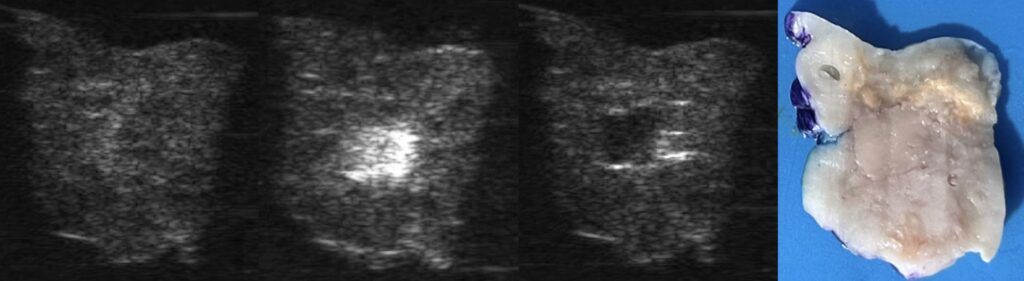
Currently, new clinical applications of histotripsy methods are rapidly developing, such as local fractionation of tumors, targeted drug delivery without artificial administration of contrast agents, liquefaction of blood clots and large hematomas, enhanced release of specific biomarkers for non-invasive cancer diagnostics, treatment of abscesses, combination immunotherapy, etc.
Research at LIMU
- development of complex methods for planning HIFU exposure in clinical settings;
- transducer design, including phased arrays, to achieve the required amplitudes of shock fronts at the focus;
- studies of cavitation effects in tissue and physical mechanisms affecting tissue exposed to shock-wave HIFU;
- investigation of the effect of tissue acoustic properties on nonlinear focusing and field parameters in situ;
- investigation of acoustic and MRI visualization of the treated area;
- analysis of morphological and ultrastructural changes in tissue induced by ultrasound.
At LIMU Laboratory, boiling histotripsy is being developed for various clinical indications such as:
LIMU tasks
- Development of new shock-wave HIFU regimes
- Investigation of susceptibility of varied tissues and tumors to histotripsy
- Development of a threshold dose concept for histotripsy of varies target tissues and tumors
- Verification experiments on tissue phantoms
- Design of specialized transducers for specific clinical applications
Activity types
- experiments on tissue phantoms
- numerical modeling
- transducer design
Contacts
Details
[1] The histotripsy spectrum: differences and similarities in techniques and instrumentation / R.P. Williams, J.C. Simon, V.A. Khokhlova, O.A. Sapozhnikov, T.D. Khokhlova // International Journal of Hyperthermia, 40 1 1-19. DOI: 10.1080/02656736.2023.2233720
[2] Nonlinear acoustics today / O. A. Sapozhnikov, V. A. Khokhlova, R. O. Cleveland et al. // Acoustics today. — 2019. — Vol. 15, no. 3. — P. 55–64. DOI: 10.1121/AT.2019.15.3.55
[3] Shock-induced heating and millisecond boiling in gels and tissue due to high intensity focused ultrasound / M. S. Canney, V. A. Khokhlova, O. V. Bessonova et al. // Ultrasound in Medicine and Biology. — 2010. — Vol. 36, no. 2. — P. 250–267. DOI: 10.1016/j.ultrasmedbio.2009.09.010
[4] Controlled tissue emulsification produced by high intensity focused ultrasound shock waves and millisecond boiling / T. D. Khokhlova, M. S. Canney, V. A. Khokhlova et al. // Journal of the Acoustical Society of America. — 2011. — Vol. 130, no. 5. — P. 3498–3510. DOI: 10.1121/1.3626152
[5] Physical mechanisms of the therapeutic effect of ultrasound (a review) / M. R. Bailey, V. A. Khokhlova, O. A. Sapozhnikov et al. // Acoustical Physics. — 2003. — Vol. 49, no. 4. — P. 369–388. DOI: 10.1134/1.1591291
[6] Pilot ex vivo study on non-thermal ablation of human prostate adenocarcinoma tissue using boiling histotripsy / P. B. Rosnitskiy, S. A. Tsysar, M. M. Karzova et al. // Ultrasonics. — 2023. — Vol. 133. — P. 107029. DOI: 10.1016/j.ultras.2023.107029
[7] Boiling histotripsy in ex vivo human brain: proof-of-concept / E. Ponomarchuk, S. Tsysar, A. Kadrev et al. // Ultrasound in Medicine and Biology. — 2025. — Vol. 51, no. 2. — P. 312–320. DOI: 10.1016/j.ultrasmedbio.2024.10.006
[8] Pilot experiment on non-invasive non-thermal disintegration of human mucinous breast carcinoma ex vivo using boiling histotripsy / E. M. Ponomarchuk, S. A. Tsysar, D. D. Chupova et al. // Bulletin of Experimental Biology and Medicine. — 2024. — no. 1. — P. 133–136. DOI: 10.1007/s10517-024-06144-6
[9] Pilot study on boiling histotripsy treatment of human leiomyoma ex vivo / E. Ponomarchuk, S. Tsysar, A. Kvashennikova et al. // Ultrasound in Medicine and Biology. — 2024. — Vol. 50, no. 8. — P. 1255–1261. DOI: 10.1016/j.ultrasmedbio.2024.05.002
[10] Elastic properties of aging human hematoma model in vitro and its susceptibility to histotripsy liquefaction / E. M. Ponomarchuk, P. B. Rosnitskiy, S. A. Tsysar et al. // Ultrasound in Medicine and Biology. — 2024. — Vol. 50, no. 6. — P. 927–938. DOI: 10.1016/j.ultrasmedbio.2024.02.019
[11] Histology-based quantification of boiling histotripsy outcomes via resnet-18 network: Towards mechanical dose metrics / E. Ponomarchuk, G. Thomas, M. Song et al. // Ultrasonics. — 2024. — Vol. 138. — P. 107225. DOI: 10.1016/j.ultrasmedbio.2024.08.022
[12] Advancing boiling histotripsy dose in ex vivo and in vivo renal tissues via quantitative histological analysis and shear wave elastography / E. Ponomarchuk, G. Thomas, M. Song et al. // Ultrasound in Medicine and Biology. — 2024. — Vol. 50, no. 12. — P. 1936–1944. DOI:
[13] Histotripsy: a method for mechanical tissue ablation with ultrasound / Z. Xu, T. D. Khokhlova, C. S. Cho, V. A. Khokhlova // Annual Review of Biomedical Engineering. — 2024. — Vol. 26, no. 1. — P. 141–167. DOI: 10.1146/annurev-bioeng-073123-022334
[14] Initial assessment of boiling histotripsy for mechanical ablation of ex vivo human prostate tissue / V. A. Khokhlova, P. B. Rosnitskiy, S. A. Tsysar et al. // Ultrasound in Medicine and Biology. — 2023. — Vol. 49, no. 1. — P. 62–71. DOI: 10.1016/j.ultrasmedbio.2022.07.014
[15] Enhancement of boiling histotripsy by steering the focus axially during the pulse delivery / G. P. Thomas, T. D. Khokhlova, O. A. Sapozhnikov, V. A. Khokhlova // IEEE Transactions on Ultrasonics, Ferroelectrics, and Frequency Control. — 2023. — Vol. 70, no. 8. — P. 865–875. DOI: 10.1109/TUFFC.2023.3286759
[16] Quantitative assessment of boiling histotripsy progression based on color Doppler measurements / M. Song, G. P. Thomas, V. A. Khokhlova et al. // IEEE Transactions on Ultrasonics, Ferroelectrics, and Frequency Control. — 2022. — Vol. 69, no. 12. — P. 3255–3269. DOI: 10.1109/TUFFC.2022.3212266
[17] Mechanical damage thresholds for hematomas near gas-containing bodies in pulsed HIFU fields / E. M. Ponomarchuk, C. Hunter, M. Song et al. // Physics in Medicine and Biology. — 2022. — Vol. 67, no. 21. — P. 1–18. DOI: 10.1088/1361-6560/ac96c7
[18] Introduction to the Special Issue on Histotripsy: Approaches, Mechanisms, Hardware, and Applications / Z. Xu, V. A. Khokhlova, K. A. Wear et al. // IEEE Transactions on Ultrasonics, Ferroelectrics, and Frequency Control. — 2021. — Vol. 68, no. 9. — P. 2834–2836. DOI:10.1109/TUFFC.2021.3102092
[19] Partial respiratory motion compensation for abdominal extracorporeal boiling histotripsy treatments with a robotic arm / G. P. L. Thomas, T. D. Khokhlova, V. A. Khokhlova // IEEE Transactions on Ultrasonics, Ferroelectrics, and Frequency Control. — 2021. — Vol. 68, no. 9. — P. 2861–2870. DOI: 10.1109/TUFFC.2021.3075938
[20] Ultrastructural analysis of volumetric histotripsy bio-effects in large human hematomas / E. M. Ponomarchuk, P. B. Rosnitskiy, T. D. Khokhlova et al. // Ultrasound in Medicine and Biology. — 2021. — Vol. 47, no. 9. — P. 2608–2621. DOI: 10.1016/j.ultrasmedbio.2021.05.002
[21] A prototype therapy system for boiling histotripsy in abdominal targets based on a 256 element spiral array / C. R. Bawiec, T. D. Khokhlova, O. A. Sapozhnikov et al. // IEEE Transactions on Ultrasonics, Ferroelectrics, and Frequency Control. — 2021. — Vol. 68, no. 5. — P. 1496–1510. DOI: 10.1109/TUFFC.2020.3036580
[22] Effect of stiffness of large extravascular hematomas on their susceptibility to boiling histotripsy liquefaction in vitro / T. D. Khokhlova, J. C. Kucewicz, E. M. Ponomarchuk et al. // Ultrasound in Medicine and Biology. — 2020. — Vol. 46, no. 8. — P. 2007–2016. DOI: 10.1016/j.ultrasmedbio.2020.04.023
[23] Treating porcine abscesses with histotripsy: a pilot study / T. J. Matula, Y.-N. Wang, T. D. Khokhlova et al. // Ultrasound in Medicine and Biology. — 2020. — Vol. 47, no. 3. — P. 603–619. DOI: 10.1016/j.ultrasmedbio.2020.10.011
[24] Pilot in vivo studies on transcutaneous boiling histotripsy in porcine liver and kidney / T. D. Khokhlova, G. R. Schade, Y. N. Wang et al. // Scientific reports. — 2019. — Vol. 9. — P. 20176. DOI: 10.1038/s41598-019-56658-7
[25] Histotripsy: the next generation of high‐intensity focused ultrasound for focal prostate cancer therapy / T. J. Dubinsky, T. D. Khokhlova, V. A. Khokhlova, G. A. Schade // Journal of Ultrasound in Medicine. — 2019. — Vol. 39, no. 6. — P. 1057–1067. DOI: 10.1002/jum.15191
[26] Simulation of nonlinear trans-skull focusing and formation of shocks in brain using a fully populated ultrasound array with aberration correction / P. B. Rosnitskiy, P. V. Yuldashev, O. A. Sapozhnikov et al. // Journal of the Acoustical Society of America. — 2019. — Vol. 146, no. 3. — P. 1786–1798. DOI: 10.1121/1.5126685
[27] Mechanical decellularization of tissue volumes using boiling histotripsy / Y.-N. Wang, T. D. Khokhlova, S. V. Buravkov et al. // Physics in Medicine and Biology. — 2018. — Vol. 63, no. 23. — P. 1–11. DOI: 10.1088/1361-6560/aaef16
[28] Dependence of inertial cavitation induced by high intensity focused ultrasound on transducer F-number and nonlinear waveform distortion / T. Khokhlova, P. Rosnitskiy, C. Hunter et al. // Journal of the Acoustical Society of America. — 2018. — Vol. 144, no. 3. — P. 1160–1169. DOI: 10.1121/1.5052260
[29] Inactivation of planktonic escherichia coli by focused 1-MHz ultrasound pulses with shocks: efficacy and kinetics upon volume scale-up / A. A. Brayman, B. E. Macconaghy, Y. N. Wang et al. // Ultrasound in Medicine and Biology. — 2018. — Vol. 44, no. 9. — P. 1996–2008. DOI: 10.1016/j.ultrasmedbio.2018.05.010
[30] On the possibility of using multi-element phased arrays for shock-wave action on deep brain structures / P. Rosnitskiy, L. Gavrilov, P. Yuldashev et al. // Acoustical Physics. — 2017. — Vol. 63, no. 5. — P. 531–541. DOI: 10.1134/S1063771017050104
[31] Dependence of boiling histotripsy treatment efficiency on HIFU frequency and focal pressure levels / T. D. Khokhlova, Y. A. Haider, A. D. Maxwell et al. // Ultrasound in Medicine and Biology. — 2017. — Vol. 43, no. 9. — P. 1975–1985. DOI: 10.1016/j.ultrasmedbio.2017.05.001
[32] A prototype therapy system for transcutaneous application of boiling histotripsy / A. D. Maxwell, P. V. Yuldashev, W. Kreider et al. // IEEE Transactions on Ultrasonics, Ferroelectrics, and Frequency Control. — 2017. — Vol. 64, no. 10. — P. 1542–1557. DOI:
[33] Boiling histotripsy ablation of renal carcinoma in a chronic rat model / W. Brisbane, T. Khokhlova, S. Whang et al. // Journal of Urology. — 2017. — Vol. 197, no. 4. — P. 1329–1330. DOI: 10.1016/j.juro.2017.02.3109
[37] Inactivation of planktonic escherichia coli by high intensity focused ultrasound pulses / T. J. Matula, A. Brayman, Y.-N. Wang et al. // Proceedings of Meetings on Acoustics. — 2017. — Vol. 32, no. 1. — P. 020009/1–020009/6. DOI: 10.1121/2.0000729
[38] Histotripsy methods in mechanical disintegration of tissue: Towards clinical applications / V. A. Khokhlova, J. B. Fowlkes, W. W. Roberts et al. // International Journal of Hyperthermia. — 2015. — Vol. 31, no. 2. — P. 145–162. DOI: 10.3109/02656736.2015.1007538
[34] Histological and biochemical analysis of mechanical and thermal bioeffects in boiling histotripsy lesions induced by high intensity focused ultrasound / Y.-N. Wang, T. Khokhlova, M. Bailey et al. // Ultrasound in Medicine and Biology. — 2013. — Vol. 39, no. 3. — P. 424–438. DOI: 10.1016/j.ultrasmedbio.2012.10.012