
Prostate cancer (PC) is the second most common malignant neoplasm in men and the fifth most common cause of cancer-related death in men. The use of high-intensity focused ultrasound (HIFU), along with cryoablation, laser thermal ablation, radiofrequency ablation and photodynamic therapy, is one of the actively developing non-invasive approaches of focal therapy of localized low- and intermediate-risk PC. Localized tumors are destroyed with the use focusing transducers that locally concentrate the ultrasound field in the pathological area. Ultrasound exposure leads to absorption of acoustic energy at the focus causing local tissue heating and its thermal coagulation necrosis.
However, the HIFU method based on thermal ablation of prostate tissue has limitations associated with heat diffusion from the target area and difficulties with real-time procedure control. LIMU is developing a method termed boiling histotripsy that utilizes short and rarely repeated focused ultrasound pulses of such high power that high-amplitude shock waves are formed in the focal area, leading to purely mechanical fractionation of tissue at the focus. This approach eliminates the risk of heat diffusion and ensures ablation precision, as well as allows for reliable control of the treated site, since hyperechoic vapor bubbles generated during boiling histotripsy are clearly visible in the ultrasound image of the target zone.
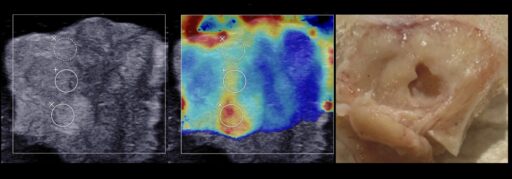
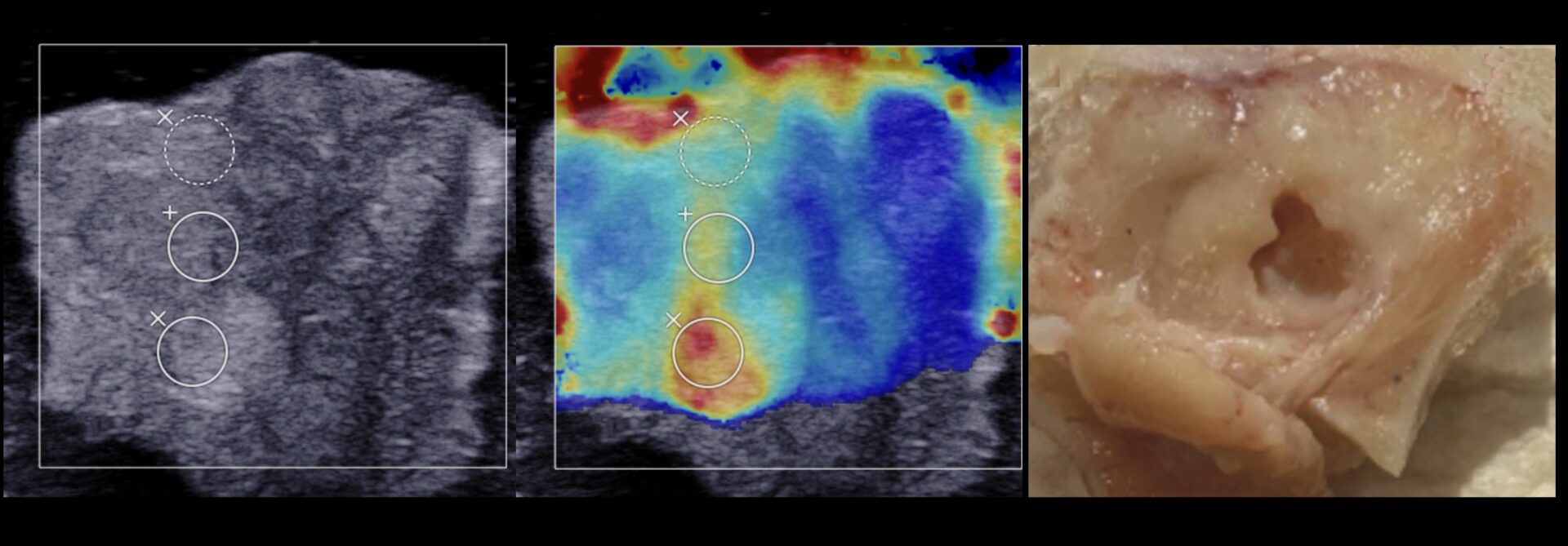
Our team has recently demonstrated the fundamental possibility of mechanical fractionation of human prostate tissues ex vivo using boiling histotripsy leading to target tissue liquefaction down to subcellular fragments as was confirmed histologically and by electron microscopy. The clinical relevance in terms of mechanical properties of the tissue samples was confirmed with diagnostic procedure of shear wave elastography.
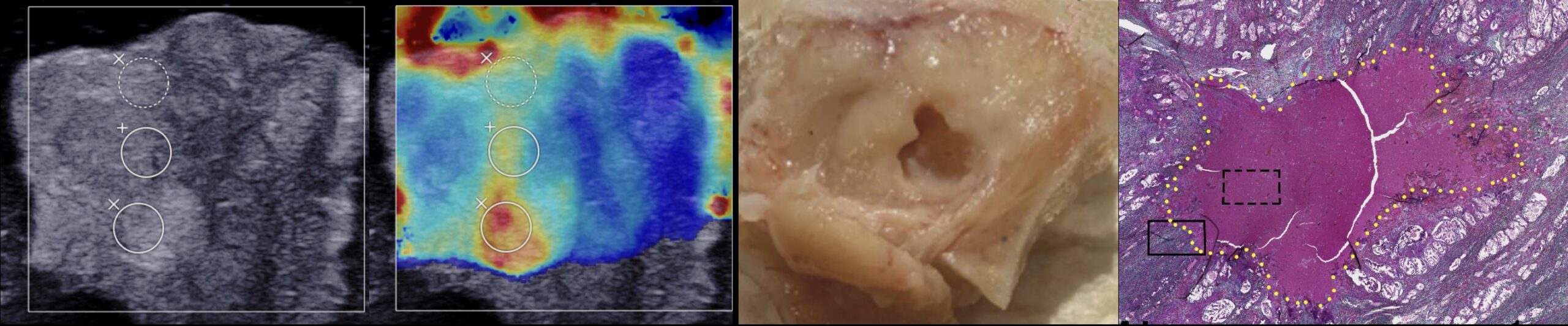
We have also recently demonstrated the feasibility of boiling histotripsy to produce localized mechanical lesions in human prostate cancer samples ex vivo.
Currently, our team is leading the research on a larger sample batch to study the response of various prostate tumors to mechanical fractionation with boiling histotripsy, the influence of their elastic properties on this response, as well as to determine the range of optimal exposure parameters for the effective and rapid fractionation of various prostate tumors.
Contacts
Details
- in our talk
- in our invited lecture by G. Schade
- in our lecture
- in our webinar
- in a short video
- in the papers below
[1] Pilot ex vivo study on non-thermal ablation of human prostate adenocarcinoma tissue using boiling histotripsy / P. B. Rosnitskiy, S. A. Tsysar, M. M. Karzova et al. // Ultrasonics. — 2023. — Vol. 133. — P. 107029. DOI: 10.1016/j.ultras.2023.107029
[2] Initial assessment of boiling histotripsy for mechanical ablation of ex vivo human prostate tissue / V. A. Khokhlova, P. B. Rosnitskiy, S. A. Tsysar et al. // Ultrasound in Medicine and Biology. — 2023. — Vol. 49, no. 1. — P. 62–71. DOI: 10.1016/j.ultrasmedbio.2022.07.014
[3] Histotripsy: the next generation of high‐intensity focused ultrasound for focal prostate cancer therapy / T. J. Dubinsky, T. D. Khokhlova, V. A. Khokhlova, G. A. Schade // Journal of Ultrasound in Medicine. — 2019. — Vol. 39, no. 6. — P. 1057–1067. DOI: 10.1002/jum.15191
[4] The histotripsy spectrum: differences and similarities in techniques and instrumentation / R.P. Williams, J.C. Simon, V.A. Khokhlova, O.A. Sapozhnikov, T.D. Khokhlova // International Journal of Hyperthermia, 40 1 1-19. DOI: 10.1080/02656736.2023.2233720
[5] Nonlinear acoustics today / O. A. Sapozhnikov, V. A. Khokhlova, R. O. Cleveland et al. // Acoustics today. — 2019. — Vol. 15, no. 3. — P. 55–64. DOI: 10.1121/AT.2019.15.3.55
[6] Shock-induced heating and millisecond boiling in gels and tissue due to high intensity focused ultrasound / M. S. Canney, V. A. Khokhlova, O. V. Bessonova et al. // Ultrasound in Medicine and Biology. — 2010. — Vol. 36, no. 2. — P. 250–267. DOI: 10.1016/j.ultrasmedbio.2009.09.010
[7] Controlled tissue emulsification produced by high intensity focused ultrasound shock waves and millisecond boiling / T. D. Khokhlova, M. S. Canney, V. A. Khokhlova et al. // Journal of the Acoustical Society of America. — 2011. — Vol. 130, no. 5. — P. 3498–3510. DOI: 10.1121/1.3626152
[8] Physical mechanisms of the therapeutic effect of ultrasound (a review) / M. R. Bailey, V. A. Khokhlova, O. A. Sapozhnikov et al. // Acoustical Physics. — 2003. — Vol. 49, no. 4. — P. 369–388. DOI: 10.1134/1.1591291
[9] Histotripsy: a method for mechanical tissue ablation with ultrasound / Z. Xu, T. D. Khokhlova, C. S. Cho, V. A. Khokhlova // Annual Review of Biomedical Engineering. — 2024. — Vol. 26, no. 1. — P. 141–167. DOI: 10.1146/annurev-bioeng-073123-022334