
On April 17, 2025, a scientific webinar ISTU On-Air was held by the International Society of Therapeutic Ultrasound, where LIMU research fellow Alisa Krokhmal presented her research work “Comparative study of experimental and numerical propagation of an ultrasound beam through the skull“. The webinar featured a special session titled “Rising Scientists in Therapeutic Ultrasound” and addressed current challenges and achievements in neuromodulation.
The talk was based on a recently published paper in Physics in Medicine and Biology (Q1, IF 3.3) co-authored with colleagues from University College London and focused on the accuracy of numerical modeling of ultrasound beam propagation through the skull. Key factors affecting computational modeling precision were analyzed.
1. Attenuation coefficient in the skull
The amplitude of sound pressure at the focus is fundamentally influenced by the assigned attenuation coefficient in the skull. Currently, there is no widely accepted method for converting CT scan images of the skull into an attenuation coefficient. Using tabulated values, which are uniform for skulls of varying structure and density, leads to errors in amplitude averaging around 15%, and in some cases, up to 60%.
2. Transducer positioning in numerical models
The accuracy of focus positioning depends on how the transducer is defined in the numerical model. If the source is based on an experimentally measured hologram, it is crucial to ensure that the transducer surface plane and the hologram measurement plane are strictly parallel. Even a slight angular deviation must be compensated for; otherwise, the focus may shift by several millimeters.
3. Surface elastic waves in the skull:
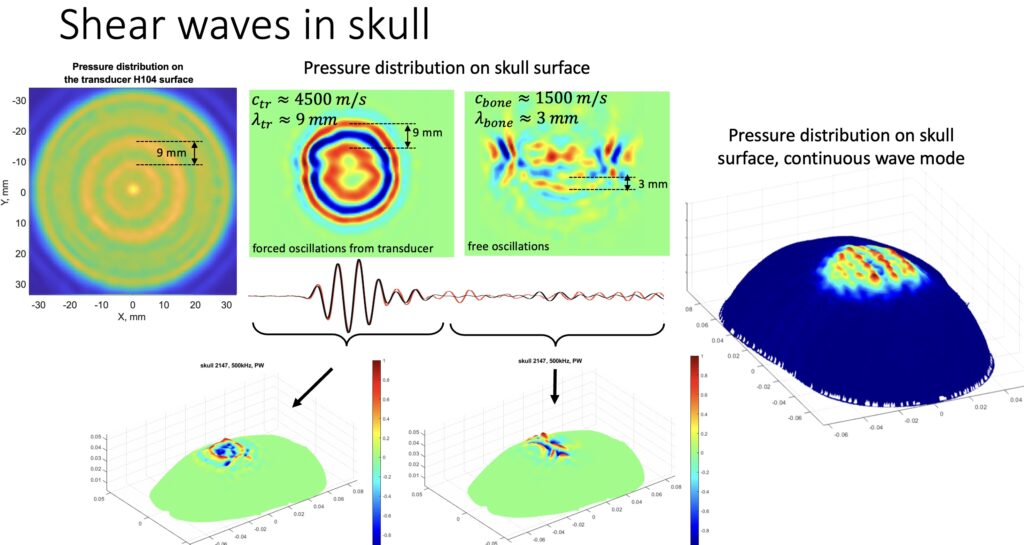
The size and position of the focal spot are affected by surface elastic waves, which are inevitably excited in the skull. If the incident angle of the ultrasound beam is too large, a significant portion of the wave converts into an elastic wave, making a purely fluid skull model insufficient for calculations.
4. Limitations of the k-Wave simulation tool
One limitation of the k-Wave computational suite, widely used for numerical modeling of ultrasound propagation through the skull, is its inability to account for reflective boundary conditions at the source. In reality, reflections between the skull surface and the emitter occur, which is particularly important in continuous-wave ultrasound applications.
The webinar recording is available on the ISTU website and on our website.