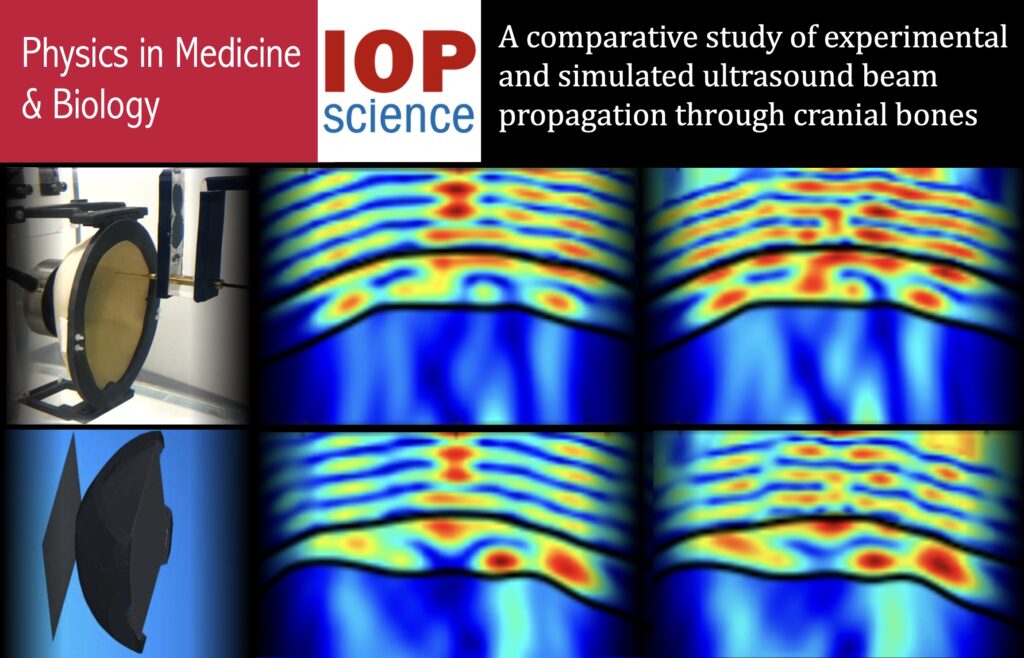
The high-impact journal Physics in Medicine and Biology (Q1, IF 3.3) published a paper on experimental evaluation of numerical modeling accuracy for transcranial ultrasound. The study was conducted by our researcher Alisa Krokhmal in collaboration with University College London.
Transcranial ultrasound is actively used in HIFU therapy for neurodegenerative diseases and neuromodulation, yet its efficacy and safety directly depend on the accurate assessment of the ultrasound field within the brain.
This study was aimed at experimental evaluation of the accuracy of numerical modeling for focused ultrasound propagation through ex vivo skull bones. Acoustic fields were measured after ultrasound transmission through four human skull samples across a frequency range of 270 kHz to 1 MHz, including both pulsed and quasi-continuous modes. Numerical simulations were performed using the open-source k-Wave package, which incorporated two types of sources:
- an equivalent source hologram derived from experimental data;
- a simplified spherical source model with uniform pressure distribution.
Acoustic properties of the skull, such as sound speed and density, were determined from CT images, while the absorption coefficient was assigned based on literature data.
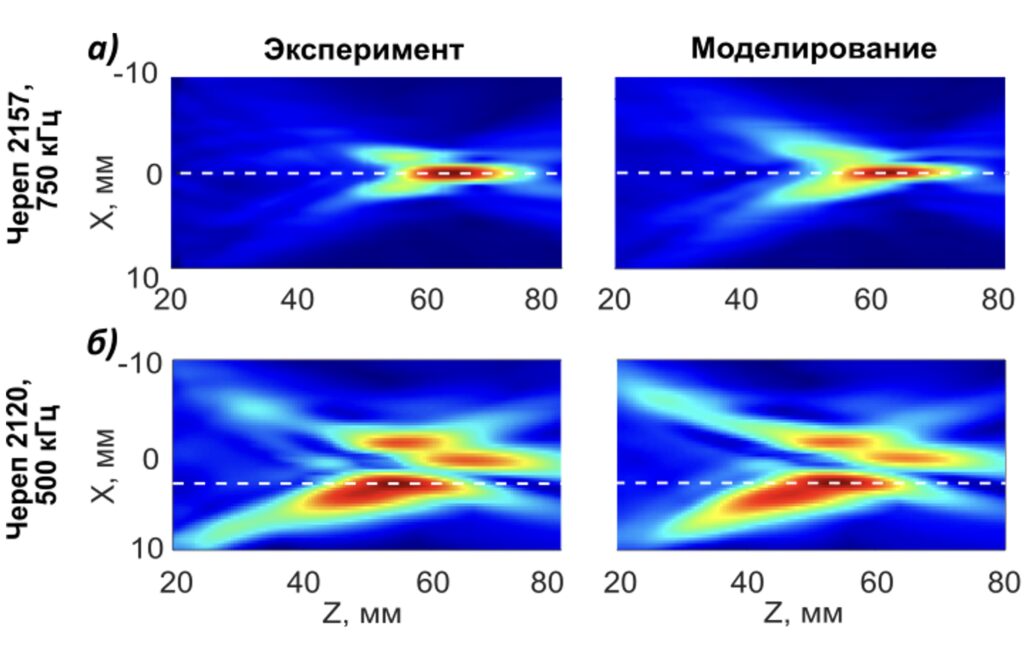
The results revealed an average peak pressure amplitude modeling error of 15%, with focus positioning errors reaching 2.7 mm and focal zone volume (-6 dB) errors of 35%. The lowest discrepancies were observed at mid-range frequencies (500–750 kHz), whereas errors increased at 1 MHz due to strong aberrations in heterogeneous skull regions. Notably, the simplified spherical source model demonstrated accuracy comparable to the holographic approach, offering potential for streamlined clinical calculations. Additionally, the linear frequency dependence of the absorption coefficient did not always align with empirical data, particularly for porous samples.
The study confirmed that k-Wave simulations with CT data can predict focal zone position and shape with acceptable accuracy. However, pressure amplitude errors (up to 60% in some cases) highlight the necessity of accounting for individual skull properties and incorporating additional safety margins during treatment planning.
These findings hold significant practical value for developing personalized treatment protocols and optimizing computational resources through simplified models. Future applications may enhance the precision and safety of transcranial ultrasound interventions, thereby expanding their clinical utility.
For more details – see the text of the paper. Learn more from our talk at «ISTU-2024».